
Software Development R&D Claims: Qualifying Expenditures Guide

R&D tax relief can help UK software companies reduce their tax bills by claiming costs tied to innovation. To qualify, your project must solve challenges not easily addressed by existing solutions. Key eligible costs include staff wages, software licences, cloud computing, and subcontractor fees. Recent rule changes affect claims from April 2023 and April 2024, such as including cloud services and limiting overseas expenses. Proper documentation and accurate cost allocation are critical to staying compliant with HMRC's requirements.
Key Points:
- Staff Costs: Claim a percentage of salaries based on R&D involvement.
- Software Costs: Subscription-based tools for R&D qualify; capitalised software does not.
- Subcontractor Costs: Restricted to UK work after April 2024, with specific exemptions.
- Cloud and Data Costs: Eligible since April 2023, but only for direct R&D use.
- Common Mistakes: Avoid claiming routine tasks, unpaid costs, or general admin expenses.
For accurate claims and to navigate complex rules, maintaining detailed records and seeking expert advice is essential.
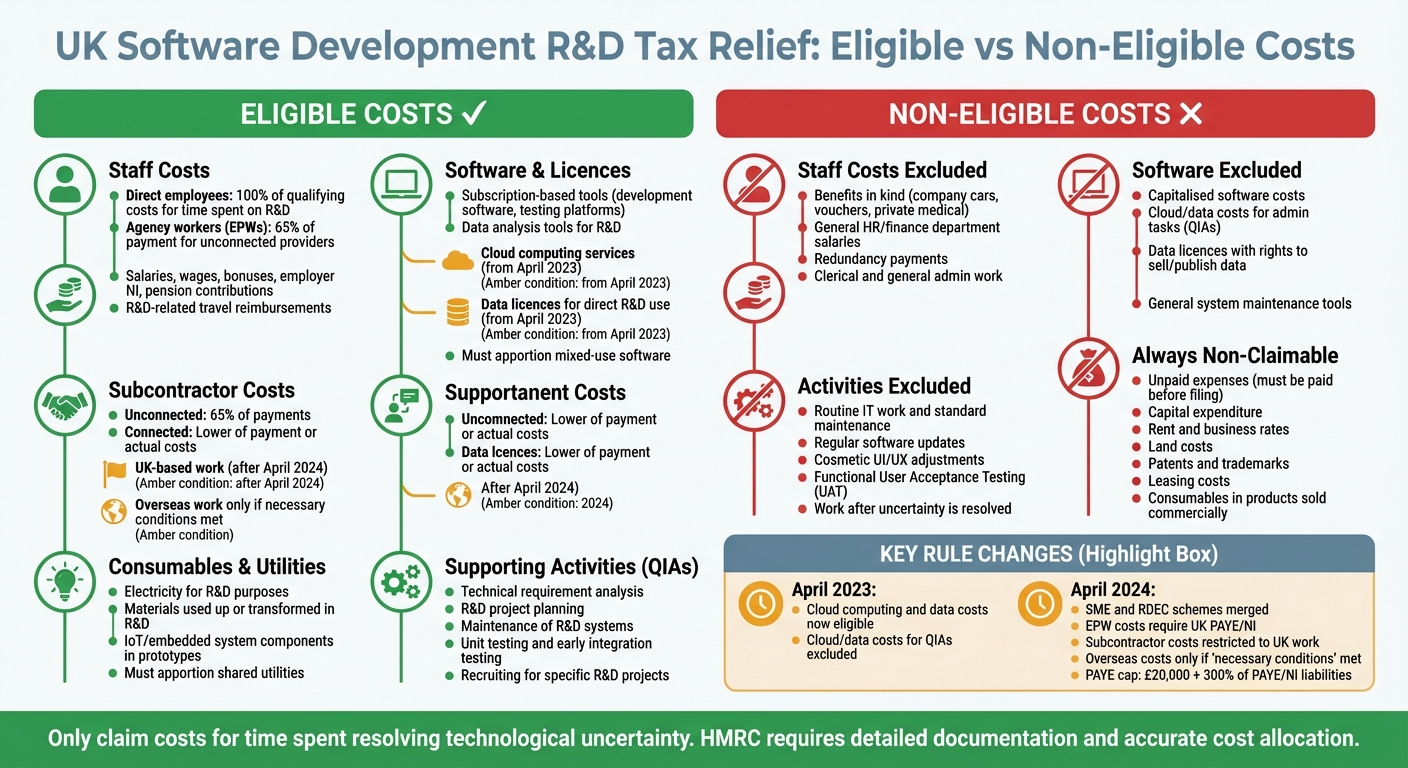
UK Software R&D Tax Relief: Eligible vs Non-Eligible Costs Guide
R&D Tax Relief - Changes in Research and Development Tax Relief 2024
sbb-itb-8ea0335
Staff Costs: Employees and Agency Workers
Staff costs represent a significant portion of R&D claims in software development. These claims can cover salaries, wages, bonuses, employer Class 1 National Insurance Contributions, and employer pension contributions for employees involved in R&D projects. This includes developers tackling technical uncertainties and staff engaged in "qualifying indirect activities" - such as maintaining R&D equipment like servers, recruiting specifically for R&D projects, or managing R&D-related administration.
Direct Employee Costs
For employees directly involved in R&D, you can claim 100% of their qualifying costs, but only for the percentage of their time spent on R&D tasks. For instance, if a developer dedicates 60% of their working hours to resolving technical challenges in your software project, you can claim 60% of their costs. This calculation must reflect the actual time spent on R&D activities.
Reimbursement for R&D-related expenses, such as travel, is eligible for claims, while benefits in kind - like company cars, vouchers, or private medical insurance - are not. Similarly, costs related to general corporate support, such as HR or finance department salaries not tied to specific R&D projects, are excluded.
Agency Workers and the PAYE Cap
Agency workers, also known as externally provided workers (EPWs), must operate under your direct supervision but are not considered employees or directors. For unconnected staff providers, you can claim 65% of the payment made to the agency for R&D work. For connected providers, the claimable amount is the lower of either the full payment or the provider's actual staffing costs (including wages, National Insurance, and pensions paid to the worker).
From 1 April 2024, EPW costs will generally need to be subject to UK PAYE and National Insurance to qualify, except in cases where specific overseas exemptions apply. For loss-making SMEs, a PAYE cap limits the R&D credit to £20,000 plus 300% of total PAYE and National Insurance liabilities. However, this cap can be avoided if your R&D projects are managed "wholly or mainly" by your employees and spending on connected EPWs and subcontractors remains below 15% of your total qualifying R&D expenditure.
Next, we’ll look at how software licence costs play a role in your R&D claims.
Software Licence Costs for R&D
Software licences used in R&D projects can qualify for tax relief, but only if the expenditure is subscription-based rather than capitalised. This includes tools like development software, testing platforms, and data analysis tools that help address technological uncertainties. From 1 April 2023, the scope of qualifying costs expanded to include data licences and cloud computing services. Below, we’ll break down which software licences qualify and how to handle costs when software is used for both R&D and non-R&D purposes.
Which Software Licences Qualify
To qualify, software must be directly involved in R&D or in qualifying indirect activities (QIAs). Examples include development tools like compilers, CAD software for experimental designs, or simulation platforms used to tackle technical challenges. Software acting as a tool within a broader R&D project - such as data processing software in a Life Science study - can also meet the criteria.
However, there are exclusions. Data licences and cloud computing services linked to QIAs are specifically excluded. Similarly, data feeds or cloud storage used for HR or general administrative tasks do not qualify. Costs for data licences that allow you to sell, publish, or share data with third parties are also excluded, unless sharing is incidental to your R&D work.
If software serves both R&D and non-R&D purposes, the next section explains how to apportion the costs.
Splitting Costs for Mixed-Use Software
When software is used for both R&D and non-R&D activities, costs need to be divided. HMRC suggests using a practical approach, such as basing the apportionment on staff numbers, staff hours, or the proportion of data storage allocated to R&D. According to HMRC:
"If a company offers a reasonable apportionment basis HMRC do not envisage detailed enquiries being desirable to establish a slightly more accurate alternative."
For software directly tied to R&D, calculate the qualifying percentage by comparing R&D staff costs to total staff costs. Use this ratio to apportion costs for direct software. For indirect software, apply a similar method using the total company staff costs. Ensure you keep strong evidence - like detailed project logs - to back up your calculations.
Subcontractor Costs: UK and Overseas Rules
Subcontractor costs play a big role in software development R&D claims. Until 1 April 2024, companies could claim relief on third-party R&D work, no matter where it was carried out. However, from this date, new territorial restrictions and a "decision-maker principle" have been introduced. This principle ties relief to the company directing and overseeing the R&D project.
How subcontractor costs are treated depends on whether the subcontractor is connected or unconnected. For connected subcontractors, the qualifying amount is limited to the lower of the payment made or the subcontractor’s actual expenditure (including staff costs, software, and consumables). If a non-connected company wants connected status, it must jointly elect with HMRC within two years of the end of the accounting period. Let’s take a closer look at how these rules applied before 1 April 2024.
SME Rules Before 1 April 2024
For accounting periods starting before 1 April 2024, the SME scheme allowed companies to claim relief for R&D work contracted to any third party, regardless of where the work was carried out. There were no territorial restrictions, so costs for overseas subcontractors were fully eligible.
In contrast, large companies under the RDEC scheme generally couldn’t claim relief for R&D contracted to other companies unless the subcontractor was a qualifying body (such as a university or charity), an individual, or a partnership of individuals. SMEs carrying out subsidised R&D - like work commissioned by a large company - had to claim those costs under the less generous RDEC scheme.
Merged Scheme Rules After 1 April 2024
The rules have tightened further under the merged scheme. As Innovation Plus explains:
"The central principle is that relief follows the decision-maker – the company that contracts out the R&D and drives the innovation."
For unconnected subcontractors, companies can claim 65% of the payments made for R&D work. However, the merged scheme introduces territorial restrictions, which significantly limit overseas costs. Relief is generally restricted to R&D activities carried out in the UK. Overseas costs are only eligible if certain "necessary conditions" are met, such as geographical, environmental, or legal factors that cannot be replicated in the UK. Deloitte UK provides further clarity:
"Relief will only be available for R&D carried out overseas where there are necessary conditions that are present in the overseas location but not in the UK and that it would be wholly unreasonable to replicate in the UK."
Importantly, lower labour costs or a shortage of skilled workers in the UK are specifically excluded as valid reasons for claiming overseas subcontractor costs. Companies must carefully determine where the R&D is conducted and allocate costs fairly if the work spans multiple locations. Maintaining strong evidence - such as project plans, meeting notes, or correspondence showing why the work couldn’t be duplicated in the UK - is essential to support any overseas claims.
Even if your customer is an "ineligible body" (such as a charity, university, or an overseas company not subject to UK corporation tax), you may still be able to claim relief when acting as the subcontractor.
For expert guidance on navigating these complex rules and optimising your R&D claims, consider reaching out to Zest R&D Tax Advisors.
Consumables, Cloud Computing, and Data Costs
Software projects often come with expenses tied to consumables, cloud services, and data licences. From 1 April 2023, updated rules for claiming cloud and data costs came into effect. Just like with staff and subcontractor costs, accurate calculations are critical to maximise your R&D tax claim. Below, we break down how to identify which physical and digital costs qualify.
Utilities and Prototyping Materials
Consumables refer to materials that are either used up or physically altered during R&D work. For software projects, this often includes utilities like electricity used exclusively for R&D purposes. Hardware-related projects, such as those involving IoT devices or embedded systems, may also qualify if electronic components in prototypes are effectively transformed during the R&D process. However, if you sell the prototype, the value of consumables embedded in the product is generally not eligible for relief.
HMRC allows practical methods to apportion shared utility costs. For example, if your electricity supply is shared between R&D and non-R&D activities, you can calculate the R&D portion based on factors like staff headcount or workspace size. HMRC provides guidance on this, stating:
"HMRC would accept that expenditure on heating or lighting the part of the property used directly for R&D was being incurred directly on R&D, even if there were trivial non-R&D activities also taking place."
Cloud and Data Costs
Digital services like cloud computing and data storage also require careful allocation. From 1 April 2023, cloud and data costs became eligible for R&D claims. This includes expenses for remote storage, operating systems, platforms, and hosted services such as AWS, Microsoft Azure, or Google Cloud.
However, certain activities, like administrative tasks or general system maintenance (known as Qualifying Indirect Activities, or QIAs), are excluded from relief for cloud and data costs. To support your claim, maintain detailed records of usage, including access logs, duration, and the specific R&D purpose. For services used across multiple activities, you can apportion costs using objective metrics, such as staff hours or data usage ratios.
Be mindful of your data licence agreements. If the contract gives you rights to sell, publish, or share the data with third parties, the associated costs are generally excluded from relief. Reviewing contracts to confirm that such rights do not apply is essential to avoid disqualification.
Other Qualifying Costs: Contributions and Supporting Activities
Beyond staff, subcontractor, and software licence costs, there are additional contributions and supporting activities that can play a role in your R&D claim. These costs are often overlooked but can add real value to your claim. Let’s break this down, starting with independent contributions and then moving to indirect supporting activities.
Independent R&D Contributions
Independent R&D contributions refer to payments made to third parties for research connected to your trade, without directly contracting the work. These contributions could be claimed under the RDEC scheme if paid to qualifying organisations like universities, charities, or scientific research bodies, provided the recipient isn’t linked to your company.
However, this category has been abolished for accounting periods starting on or after 1 April 2024. If your accounting period began before this date, you can still include these contributions, but only under RDEC - they were never claimable under the SME scheme. Be sure to double-check your accounting dates, especially if you’ve been funding university research or similar initiatives, as this change could impact your claim.
Supporting Activities That Qualify
Qualifying indirect activities (QIAs) include tasks that support your R&D projects. For example, in software development, this might cover technical requirement analysis (when it’s tied to resolving uncertainties), project planning and scheduling specific to R&D, and maintenance of R&D-related computer systems. Testing activities like unit testing and early integration testing can also qualify, but only if they’re aimed at refining development rather than simply validating functionality.
HMRC provides a clear guideline here:
"To be included in an R&D project the purpose of the testing work should be to feed back into the development, not to validate that it definitely works properly once the technological uncertainties have been resolved."
This means that functional User Acceptance Testing (UAT), which focuses on "look and feel", usually doesn’t qualify. Similarly, while recruiting a specialist scientist for a specific R&D project is eligible, general HR activities are not.
For support staff who divide their time between R&D and other responsibilities, you’ll need to apportion their costs based on the actual time spent on R&D. Additionally, from 1 April 2023, costs related to data and cloud computing for QIAs are no longer claimable - these must now fall under direct R&D costs.
Next, we’ll cover common pitfalls and non-eligible costs to help you keep your claim compliant.
Common Mistakes and Non-Eligible Costs
R&D claims often fail when businesses include unpaid costs or expenses that don’t qualify. HMRC clearly states that unpaid expenses are not eligible. If you haven’t settled an invoice by the time you file your Corporation Tax return, it must be excluded from your claim.
Another frequent mistake is claiming routine IT work that doesn’t involve any technological uncertainty. Tasks like standard system maintenance, regular software updates, or implementing well-established solutions don’t count as R&D. Similarly, activities that occur after development - such as fine-tuning, cosmetic UI/UX adjustments, or functional User Acceptance Testing (UAT) - must also be excluded once the technological uncertainty has been resolved. HMRC explains:
"R&D starts when work begins to resolve the scientific or technological uncertainty and ends when that uncertainty is resolved, or the work to resolve it stops".
These rules ensure that only activities genuinely advancing technology are eligible.
Errors in claiming staff costs are also common. Expenses like redundancy payments, clerical work, or maintenance tasks unrelated to R&D cannot be included. For employees who split their time between R&D and other duties, it’s crucial to accurately apportion their time. Only hours spent directly on R&D or qualifying indirect activities are claimable. Businesses also frequently misclaim indirect costs for data and cloud computing. Make sure these costs are strictly tied to qualifying R&D activities.
Certain expenses are entirely non-claimable under R&D tax relief. These include capital expenditure, rent, business rates, land costs, patents, trademarks, and leasing costs. If you sell a prototype or R&D product, the cost of consumables used in that product must also be excluded. Additionally, for unconnected subcontractors or externally provided workers, only 65% of the payment made is claimable.
To steer clear of these issues, document the point at which technological uncertainty was resolved. For mixed-use costs, use a straightforward apportionment method - HMRC favours practical approaches, such as basing calculations on staff numbers or floor area, rather than overly complex methods. Keeping clear and detailed records will help support your claim.
Summary
Staff costs can only be claimed in proportion to the time spent on R&D activities, while costs for externally provided workers and unconnected subcontractors are capped at 65% of the payments made. When tools or resources are used for both R&D and other purposes, expenses should be allocated using objective methods, such as staff headcount or project-specific usage. Consumables like power and materials are eligible for claims only if they are not part of a product sold commercially. From 1 April 2024, the SME and RDEC systems will merge into a single scheme with stricter rules, particularly on overseas expenses. These nuanced rules demand thorough attention to detail.
In the software industry, R&D activities that qualified in the past might no longer be eligible if the solutions have since become "readily available". HMRC now employs computer specialists to scrutinise claims, so businesses must be prepared to justify their claims with references to the current state of technology. This underscores the importance of maintaining detailed documentation and accurate cost allocation, as previously discussed. Expert advice is crucial for distinguishing genuine technological advancements from routine work, a line closely examined by HMRC.
Navigating these complexities often requires professional input. Zest R&D Tax Advisors specialise in helping UK software companies define project boundaries, adopt practical allocation methods, and stay compliant with the latest rules. Their fee structure, based on a percentage of the claim, ensures you only pay if your claim is successful.
Thorough documentation and sensible cost allocation are your strongest safeguards against HMRC enquiries. Whether you're submitting your first claim or adapting to the updated reliefs, expert advice can help you maximise your claim while remaining fully compliant with HMRC's expectations.
FAQs
What evidence do I need to prove my software work is genuine R&D?
To prove your software work qualifies as R&D, you need to demonstrate that it tackles scientific or technological uncertainties and is clearly connected to R&D objectives. It's crucial to maintain thorough records, including meeting notes, correspondence, agreements, or contracts related to your research activities. These documents are essential for supporting your claim and ensuring compliance with HMRC's guidelines.
How do I apportion mixed-use costs like developer time and cloud spend?
When dealing with mixed-use costs like developer time and cloud expenses, HMRC's "just and reasonable" principle is your guide. If precise timesheets for staffing costs aren't available, you can use a well-documented, credible method to allocate these expenses. For cloud spending, estimate the portion directly tied to R&D activities, ensuring your approach aligns with HMRC's expectations. Whatever method you choose, thorough documentation is key to staying compliant.
Can I still claim for overseas developers or subcontractors after April 2024?
From April 2024, R&D expenditure on overseas developers or subcontractors will generally no longer qualify for relief. However, there are exceptions. If you can demonstrate that the work could not reasonably be performed in the UK, it may still qualify. This could apply in cases where the necessary conditions, expertise, or resources for the R&D activity are not available within the UK.
Related Blog Posts
Other news stories

R&D Tax Relief for Software & SaaS Companies
R&D tax relief for software & SaaS companies: what qualifies, what HMRC treats as routine, and which costs (including cloud) you can claim.

Your R&D Tax Adviser Must Now Be Registered With HMRC — What to Check Before You Claim
Since 18 May 2026 your R&D tax adviser must be registered with HMRC. Here’s what the rule means and what to check before you let anyone file your claim.

R&D Tax Relief for Engineering Firms: Which Projects and Costs Qualify
A guide to R&D tax relief for engineering firms: which projects and costs qualify, how the merged scheme and ERIS work, and how to make a claim that survives HMRC.
