
Subcontractor Costs in R&D Claims: Rules, Rates and How to Maximise Your Claim
The Research and Development Expenditure Credit (RDEC) scheme, now part of the merged R&D scheme as of April 2024, allows UK businesses to claim tax relief for eligible R&D expenses, including subcontracted work. The key updates include:
- Who Can Claim: From April 2024, the business commissioning the R&D ("customer") typically claims relief, not the subcontractor.
- Subcontractor Costs: Claims for unconnected subcontractors are capped at 65% of payments made. For connected subcontractors, claims are limited to the lower of the payment made or their qualifying costs.
- Overseas Restrictions: Subcontracted R&D costs must generally be incurred in the UK unless specific conditions justify overseas work.
- Eligible Costs: Labour, consumables, software, and clinical trial expenses qualify, while capital expenditure, rent, and redundancy costs do not.
These changes aim to clarify eligibility, reduce double claims, and ensure compliance with HMRC requirements. Proper documentation and clear contracts are essential to maximise claims.
Qualifying Subcontractors and Expenditure Under RDEC
Which Subcontractors Qualify?
Starting from 1 April 2024, companies or individuals performing R&D can qualify, provided the contract explicitly outlines the R&D requirements. For accounting periods beginning before this date, RDEC claims for subcontracted work were limited to specific entities: qualifying bodies (such as charities, higher education institutes, scientific research organisations, or health service bodies), individuals, or partnerships where all members were individuals.
Under the updated RDEC scheme, this restriction no longer applies. Now, companies can claim for R&D work carried out by any company or individual, as long as the R&D intent was clear from the start of the contract. To demonstrate this to HMRC, businesses should include explicit R&D requirements in the contract or keep internal technical records that show R&D was necessary before the work began.
However, subcontractor R&D costs incurred outside the UK are generally not eligible unless there are specific conditions that make it entirely unreasonable to carry out the work domestically. For accounting periods starting on or after 1 April 2024, overseas costs can only be claimed if factors such as geographical, environmental, social, or legal/regulatory conditions apply. Importantly, justifications like lower overseas labour costs or a shortage of workers in the UK are not acceptable.
Next, let’s look at what types of expenditure qualify under these rules.
What Expenditure Can Be Claimed?
The amount you can claim for subcontracted R&D work depends on whether the subcontractor has a connection to your business. For unconnected subcontractors or staff providers, companies can claim 65% of the amount paid. For connected subcontractors, the claim is limited to the lower of either the full payment made or the subcontractor’s qualifying costs.
The following costs are eligible for claims:
- Labour costs: This includes salaries, wages, Class 1 National Insurance contributions, pension contributions, and bonuses.
- Externally Provided Workers (EPWs)
- Consumables: Items like materials, chemicals, fuel, power, and water.
- Software and data: Includes software licence fees, data licences, and cloud computing costs.
- Clinical trials: Payments made to volunteers.
It’s important to note that subcontractor costs must be fully paid before submitting a claim. Any unpaid costs are not eligible for tax relief. Additionally, certain expenses, such as capital expenditure, land, patents, trademarks, rent, rates, and redundancy payments, are excluded from claims.
Connected vs Unconnected Subcontractors
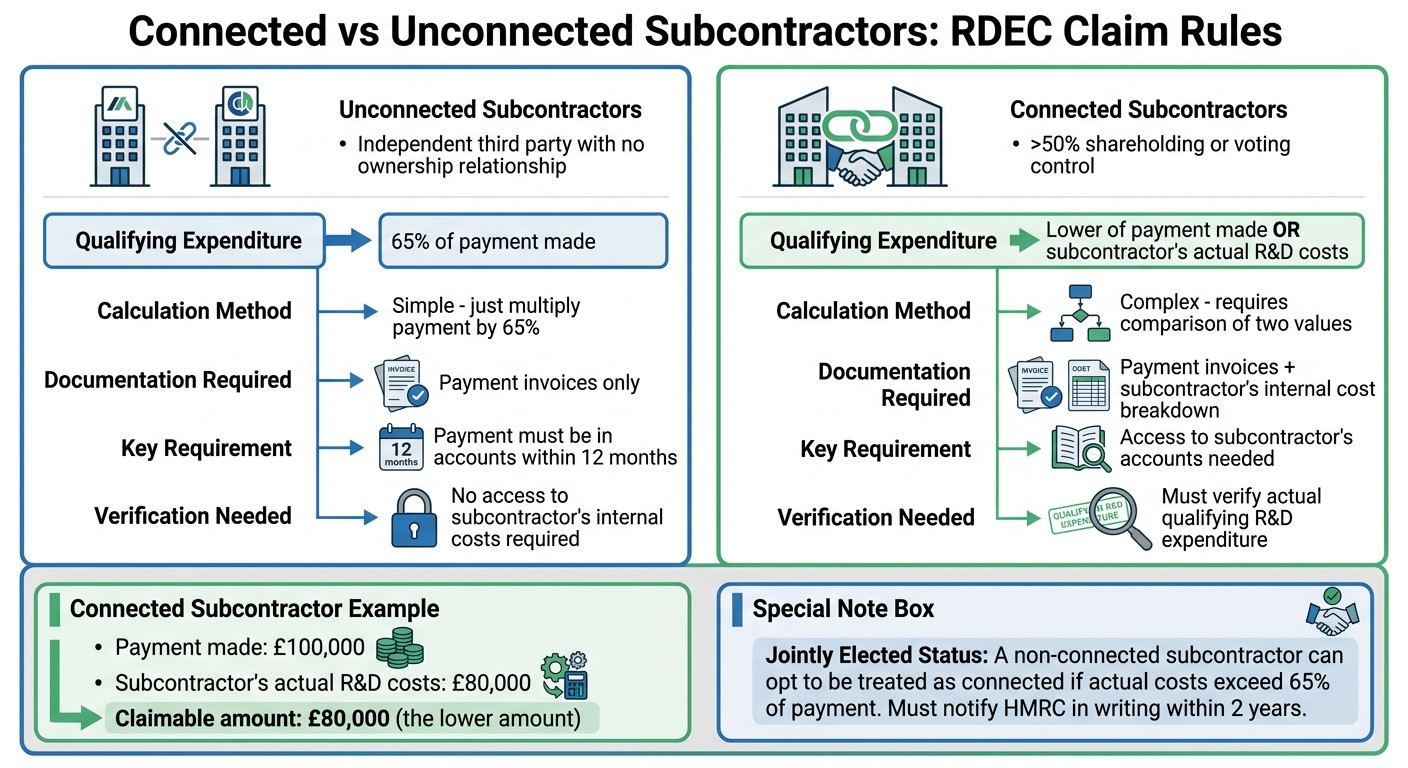
RDEC Subcontractor Rules: Connected vs Unconnected Comparison
HMRC defines a subcontractor as connected if your company holds more than 50% of its share capital or voting rights. This also includes connections through family or partnerships. Whether a subcontractor is connected or unconnected impacts how you calculate your RDEC claim. Let’s break down the rules for both scenarios.
Rules for Connected Subcontractors
When dealing with connected subcontractors, your claim is limited to the lower of two amounts: the payment you made to the subcontractor or their actual qualifying R&D expenditure. This rule ensures that internal markups don’t artificially inflate R&D costs.
Here’s an example:
- If you paid a connected subcontractor £100,000, but their actual qualifying R&D costs were £80,000, your claim would be capped at £80,000.
- On the other hand, if their costs were £120,000 and you only paid £100,000, your claim would be limited to £100,000.
To apply this rule, you’ll need access to the subcontractor’s internal accounts to verify their actual expenditure.
Interestingly, a non-connected subcontractor can opt to be treated as connected for R&D tax purposes. This applies if their actual costs exceed 65% of the payment you made. In such cases, you must notify HMRC in writing within two years of the end of the relevant accounting period.
Rules for Unconnected Subcontractors
For subcontractors with no ownership or control relationship, the calculation is much simpler. You can claim 65% of the total payment made to the subcontractor. Since this method doesn’t require verifying the subcontractor’s internal costs, it’s a more straightforward process.
To summarise, here’s how the calculation varies based on your relationship with the subcontractor:
| Subcontractor Relationship | Qualifying Expenditure Calculation | Key Requirement |
|---|---|---|
| Unconnected | 65% of the payment made | Independent third party |
| Connected | Lower of: payment made OR subcontractor's actual R&D costs | >50% shareholding or voting control |
| Jointly Elected | Treated as connected | Written notification to HMRC within 2 years |
Important Note: For unconnected subcontractors, the payment must be included in their accounts within 12 months of the end of your accounting period. This prevents double claims and maintains proper records for both parties. These rules work alongside the broader guidelines on eligible expenditure discussed earlier.
Changes to RDEC Subcontracting Rules from April 2024
From 1 April 2024, the rules for subcontracted R&D work are shifting, changing who can claim tax relief and where eligible activities must take place. Below is a breakdown of the key differences between the rules before and after this date.
Pre-2024 vs Post-2024 Rules
One of the most notable changes is in determining who can claim R&D tax relief. Previously, the contractor carrying out the work often claimed under the SME scheme. Under the new rules, the customer - the business that commissioned the R&D - will usually be the one eligible to claim the costs.
To stay compliant, it’s essential to review your subcontractor agreements to ensure work is carried out in the UK. Additionally, confirm that any EPWs are on UK payroll before including their costs in your R&D claim.
How to Claim Subcontracted R&D Costs
Calculating Qualifying Costs
Once you’ve determined that your subcontracted R&D costs meet the eligibility criteria, the next step is to calculate them accurately.
For unconnected subcontractors, you can claim 65% of the payments made to them. For connected subcontractors, you’ll need to claim the lower amount between the payment made or the actual R&D costs incurred by the subcontractor. To ensure accuracy, always obtain a detailed cost breakdown from connected subcontractors to confirm the actual R&D expenses.
Your contracts must clearly outline the technical challenges, uncertainties, intellectual property (IP) rights, and risk allocation. This level of detail is essential for satisfying HMRC requirements. Additionally, keep thorough documentation, including invoices, contracts, and payment evidence, all tied to the relevant accounting period.
Only one company in a subcontracting chain can claim relief for the same R&D activity. It’s critical to confirm that no duplicate claims exist. Keep clear and detailed contracts and records that document technical challenges, intellectual property ownership, and risk allocation to strengthen your claim.
Getting Professional Help with R&D Claims
Given the complexities of these changes, seeking professional advice can make all the difference. Experts can help ensure you're applying the correct claim rates, identifying the rightful claimant in subcontracting chains, and staying compliant with HMRC's increasingly strict guidelines.
Zest R&D Tax Advisors specialises in guiding businesses through the claim process. They can assist with preparing and submitting claims, navigating the Additional Information Form requirements, and reviewing contracts to align with the updated rules. Their expertise ensures your claim is both accurate and optimised, giving you confidence and peace of mind.
ERIS scheme: subcontractor cost rules
The Enhanced R&D Intensive Support (ERIS) scheme applies to loss-making SMEs spending at least 30% of total expenditure on R&D. Subcontractor cost rules mirror the main scheme in structure — the same 65% cap for unconnected parties, the same connected-party lower-of rule — but the net benefit is higher, up to 27% versus 15–16.2% under RDEC.
2. ERIS (Enhanced R&D Intensive Support)
ERIS is aimed at loss-making SMEs with a strong focus on R&D. To qualify, projects must dedicate at least 30% of their total expenditure to R&D activities. This scheme is more generous than the merged RDEC scheme, offering an additional 86% deduction - bringing the total to 186% - and a 14.5% payable tax credit. This translates to an effective benefit of up to 27% for eligible companies.
When it comes to subcontractor payments, ERIS follows the same merged RDEC and ERIS rules. For unconnected contractors, 65% of R&D-relevant payments are eligible, while payments to connected contractors are capped at the lower of either the payment made or the contractor's own qualifying expenditure. This expenditure includes staffing, software, and consumables but excludes further subcontracted amounts. Notably, grants and subsidies no longer reduce the qualifying expenditure.
"HMRC expects that the projects will be included in the RDEC and/or ERIS scheme claim for the company that 'takes the decision to undertake or initiate R&D'." - Jen Badger, Author, WhisperClaims
This highlights the importance of clear contracts and documentation. These records must demonstrate that your company made the decision to initiate the R&D work. Additionally, when submitting the Additional Information Form (AIF), you’ll need to provide details such as the name, registered country, and company registration number for each limited company subcontractor involved.
ERIS also comes with overseas restrictions. Subcontracted R&D must generally be performed in the UK. A strict three-part test applies: the necessary conditions for the work must not exist in the UK, must be available overseas, and it must be entirely unreasonable to replicate them domestically. Cost savings or staff availability are not considered valid reasons.
However, companies registered in Northern Ireland are typically exempt from these overseas restrictions under s1112J CTA09. That said, there is a three-year cap on the total claimable amount. If a subcontractor does work both in the UK and overseas, costs can be apportioned fairly - such as by the number of workers or days worked - to maximise the qualifying UK portion. Accurate cost allocation and thorough documentation are crucial for making the most of ERIS benefits.
FAQs
How do I prove I anticipated R&D when the contract was signed?
To demonstrate that R&D was planned right from the beginning, it's essential to provide proof that this intent was clear at the time of signing. This could include contract terms, project proposals, or correspondence that explicitly outline the R&D activities.
HMRC also stipulates that the R&D must be carried out directly for your company. If subcontractors are involved, they must perform the work themselves unless they are independent third parties. Ensure you keep detailed records to clearly show what R&D activities were intended and agreed upon.
What counts as a “connected” subcontractor for RDEC?
A connected subcontractor, in the context of RDEC (Research and Development Expenditure Credit), refers to a company that has a degree of control or influence over the other business involved. This relationship can impact both the ability to make RDEC claims and the calculation of qualifying costs. On the other hand, an unconnected subcontractor works independently and has no such influence or control over the company submitting the claim.
When can I claim for overseas subcontracted R&D after April 2024?
From April 2024, claims for subcontracted R&D work conducted overseas will largely be restricted. Only subcontractor costs for work carried out within the UK will generally qualify, unless certain exemptions are met. It's crucial to align your projects with these updated rules to prevent submitting claims that may not be eligible.
How do I prove my company is the R&D “decision-maker” in a collaborative project?
To establish your company as the R&D decision-maker, you’ll need to demonstrate that you initiated the project and intended to carry out R&D activities when entering into contracts. A signed agreement is crucial - it should outline the technical uncertainties involved, the R&D nature of the work, and the financial risks your company is taking on.
Additional supporting documents, like project plans, meeting notes, and correspondence that show your role in steering the technical progress, can further solidify your position. If you’re unsure about your documentation, Zest R&D Tax Advisors can assist in making sure everything is clear and meets compliance standards.
When does it make sense to use a CTA09/S1135 joint election for subcontractor costs?
A CTA09/S1135 joint election allows a claimant company and a contractor to be treated as connected for the purposes of R&D tax relief. This can be advantageous when the contractor’s actual R&D costs go beyond the usual 65% cap applied to payments between unconnected parties.
However, this election comes with some important considerations:
- Irrevocable Decision: Once made, the election cannot be reversed and applies to all payments under the contract.
- Submission Deadline: The election must be submitted in writing to HMRC within two years of the end of the relevant accounting period.
Given its permanence, businesses should weigh this decision carefully to ensure it aligns with their financial and strategic goals.
What evidence will HMRC expect if subcontracted R&D is carried out overseas?
If you're subcontracting R&D work overseas, HMRC mandates that you provide solid evidence to prove the work qualifies for exceptions under overseas restrictions. Essentially, you'll need to explain why it wasn't feasible to carry out the project within the UK.
To support your case, focus on gathering key documentation such as project plans, meeting minutes, and correspondence. These should clearly demonstrate that specific conditions - whether environmental, geographical, or regulatory - essential for the project were not available in the UK.
Other news stories

R&D Tax Credit Statistics 2026: Why SME Claims Are Falling (And What It Means for You)
HMRC’s R&D tax credit statistics 2026 show SME claims down 19% even as total relief rises — what’s behind the fall and what it means for your claim.

How Does the Patent Box Work? A Complete Guide for UK SMEs
How does the Patent Box work? A plain-English guide to the 10% Corporation Tax rate on patent profits — eligibility, the development condition, the R&D nexus, how to elect, and a worked example.

Autumn Budget 2026 and R&D Tax Relief: What to Watch on 28 October
The Chancellor will deliver the Autumn Budget 2026 on Wednesday 28 October. For any UK company running an R&D tax relief claim — or planning its first — it is worth knowing what is genuinely on the table before the red box opens, and what is simply noise. The short version: after three years of near-constant reform, the R&D regime is finally settling. Most of what matters for your next claim is already law. But a Budget always carries the risk of a technical tweak, and there are a few signals worth tracking. Where the R&D rules stand going into the Budget The big structural change is done. The merged RDEC scheme is now the default for accounting periods beginning on or after 1 April 2024, replacing the old separate SME and RDEC regimes. It gives a taxable expenditure credit of 20% of qualifying R&D costs — worth roughly 15% net once Corporation Tax at 25% is applied. Loss-making, R&D-intensive SMEs are the exception. If your qualifying R&D is at least 30% of total expenditure, you may instead claim under Enhanced R&D Intensive Support (ERIS), which offers a more generous deduction and a payable credit for surrenderable losses. None of […]
