
SME R&D Tax Relief Planner
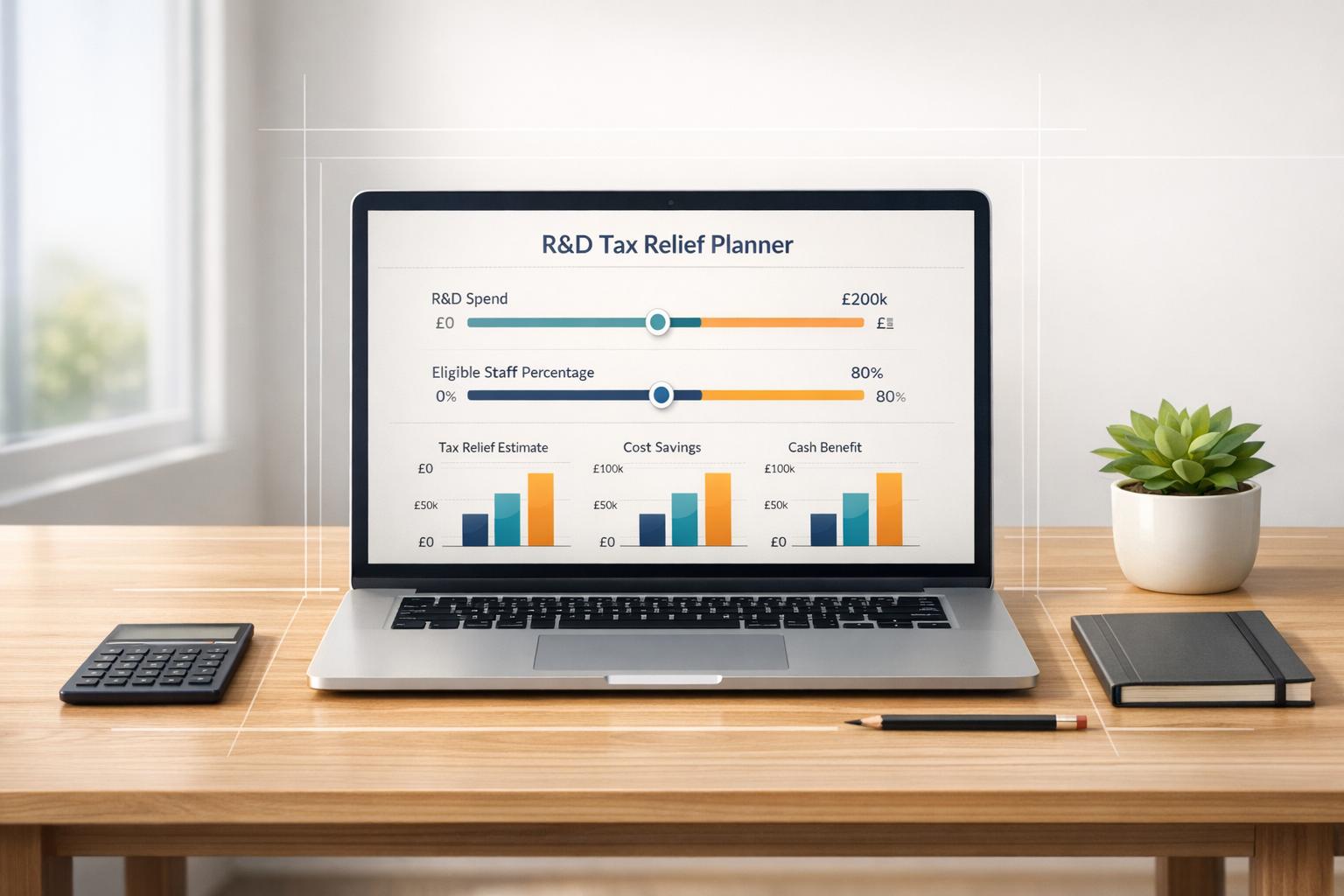
Unlock Savings with an SME R&D Tax Relief Planner
Running a small or medium business in the UK often means juggling tight budgets while pushing for innovation. That’s where R&D tax relief comes in—a government incentive designed to reward companies investing in research and development. Whether you’re in tech, manufacturing, or another sector, estimating your potential claim can reveal significant savings or cashback to fuel your growth.
Why Planning Your R&D Claim Matters
Many SMEs miss out on this benefit simply because the process feels daunting. A tool to calculate R&D tax credits takes the guesswork out of the equation. By inputting details like your project spending and financial status, you get a clear picture of what you might receive—be it a reduced tax bill or a direct payment if you’re in the red. This isn’t just about numbers; it’s about reinvesting those funds into your next big idea.
Beyond the Basics
Remember, qualifying costs aren’t limited to lab equipment. Staff time, software, and even prototype materials often count. While approval rests with HMRC, starting with a solid estimate helps you prepare. Curious about your eligibility? Dive into our free planner and see how innovation can pay off.
FAQs
Who qualifies for SME R&D tax relief in the UK?
If you’re a small or medium enterprise with fewer than 500 staff and a turnover under €100m or balance sheet under €86m, you might qualify. You’ll need to be working on projects that seek to advance science or technology through innovation. It’s not just for tech firms—manufacturing, engineering, and even food businesses often qualify if they’re solving technical challenges. Check HMRC’s guidelines or chat with a tax advisor to confirm.
What costs can I include in my R&D tax relief claim?
You can claim for costs directly tied to your R&D projects, like staff wages, software, materials, and even some subcontractor fees. Utility costs for R&D facilities might count too, but not general overheads like rent. The key is that the expense must relate to solving a scientific or technological uncertainty. Keep good records—HMRC might ask for proof during a review.
What’s the difference between a tax deduction and a cash credit?
If your business is profitable, the R&D relief reduces your corporation tax bill through a deduction based on 230% of your qualifying costs. But if you’re loss-making, you can surrender those losses for a cash credit, which is 14.5% of the enhanced loss. It’s a lifeline for startups or firms reinvesting heavily. Our tool shows both options so you can plan ahead, though HMRC has the final say.
Other news stories

R&D Tax Credit Statistics 2026: Why SME Claims Are Falling (And What It Means for You)
HMRC’s R&D tax credit statistics 2026 show SME claims down 19% even as total relief rises — what’s behind the fall and what it means for your claim.

How Does the Patent Box Work? A Complete Guide for UK SMEs
How does the Patent Box work? A plain-English guide to the 10% Corporation Tax rate on patent profits — eligibility, the development condition, the R&D nexus, how to elect, and a worked example.

Autumn Budget 2026 and R&D Tax Relief: What to Watch on 28 October
The Chancellor will deliver the Autumn Budget 2026 on Wednesday 28 October. For any UK company running an R&D tax relief claim — or planning its first — it is worth knowing what is genuinely on the table before the red box opens, and what is simply noise. The short version: after three years of near-constant reform, the R&D regime is finally settling. Most of what matters for your next claim is already law. But a Budget always carries the risk of a technical tweak, and there are a few signals worth tracking. Where the R&D rules stand going into the Budget The big structural change is done. The merged RDEC scheme is now the default for accounting periods beginning on or after 1 April 2024, replacing the old separate SME and RDEC regimes. It gives a taxable expenditure credit of 20% of qualifying R&D costs — worth roughly 15% net once Corporation Tax at 25% is applied. Loss-making, R&D-intensive SMEs are the exception. If your qualifying R&D is at least 30% of total expenditure, you may instead claim under Enhanced R&D Intensive Support (ERIS), which offers a more generous deduction and a payable credit for surrenderable losses. None of […]
