
R&D Qualifying Expenditure Checker
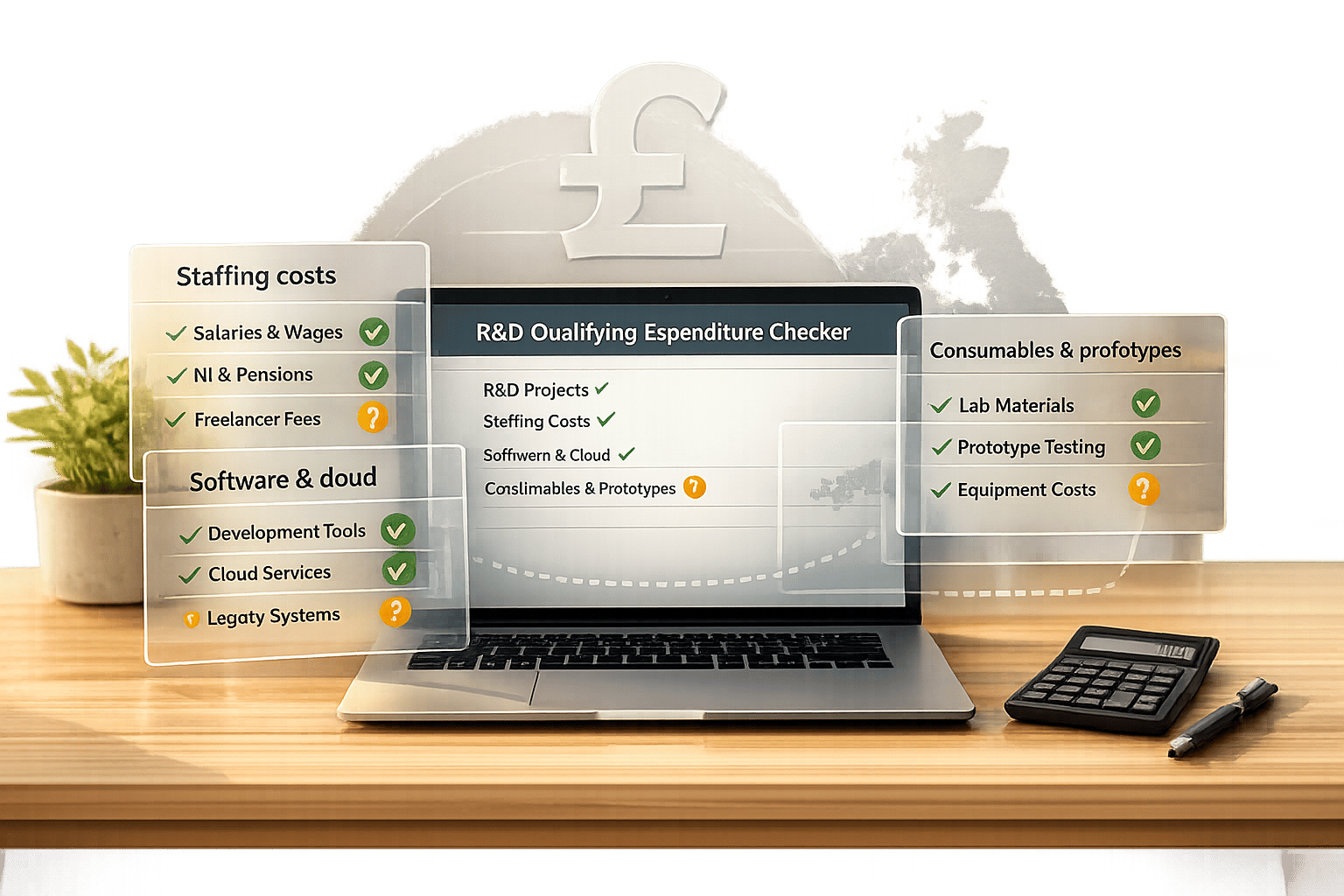
Unlock Tax Savings with R&D Tax Relief in the UK
Running a business in the UK comes with its fair share of challenges, but did you know you might be eligible for significant tax savings through research and development incentives? Many companies overlook this opportunity, missing out on credits that could fund their next big idea. If your business is tackling innovative projects or solving technical problems, you could qualify for these benefits under HMRC rules.
Why Check Your Eligibility?
Figuring out if your expenses align with the criteria for innovation tax credits doesn’t have to be a headache. Whether you’re developing new software, testing materials, or pioneering a unique process, even small projects can sometimes meet the threshold. The key is understanding whether your work seeks a genuine advance or resolves uncertainties in your field. A quick assessment can point you in the right direction and help you avoid leaving money on the table.
Take the First Step
Don’t let uncertainty stop you from exploring potential savings. Tools like our qualifying expenditure checker simplify the process, giving you clarity in minutes. Remember, though, that while these resources are handy, a chat with a tax expert ensures you’re fully covered. Start today and see how your business might benefit from this often underclaimed relief!
FAQs
What counts as R&D for tax relief in the UK?
R&D for tax purposes, as per HMRC, involves projects that seek a scientific or technological advance. This means you’re trying to solve uncertainties in your field—think developing new products, processes, or software. It’s not just lab work; even failed experiments can qualify if they aimed to push boundaries. Costs like staff wages, materials, or software often count, but routine work or purely commercial tweaks usually don’t. Our tool helps you figure out if your project fits the bill!
How accurate is this R&D tax relief checker?
Our tool gives you a solid starting point based on HMRC’s core guidelines for R&D tax credits. It’s designed to flag whether your expenses are likely to qualify by asking targeted questions. That said, it’s not a substitute for professional advice—tax rules can get tricky with specific cases. We always recommend chatting with a tax advisor to confirm eligibility and ensure you’re claiming everything you’re entitled to.
Who can claim R&D tax relief in the UK?
Most UK businesses, from startups to larger firms, can claim R&D tax relief if they’re working on innovative projects. You need to be a limited company subject to Corporation Tax, and your work should involve some kind of technical or scientific challenge. Even if your project didn’t succeed, you might still qualify. SMEs often get a higher rate of relief compared to larger companies. Use our checker to see if your specific activities might fit the criteria!
Other news stories

R&D Tax Credit Statistics 2026: Why SME Claims Are Falling (And What It Means for You)
HMRC’s R&D tax credit statistics 2026 show SME claims down 19% even as total relief rises — what’s behind the fall and what it means for your claim.

How Does the Patent Box Work? A Complete Guide for UK SMEs
How does the Patent Box work? A plain-English guide to the 10% Corporation Tax rate on patent profits — eligibility, the development condition, the R&D nexus, how to elect, and a worked example.

Autumn Budget 2026 and R&D Tax Relief: What to Watch on 28 October
The Chancellor will deliver the Autumn Budget 2026 on Wednesday 28 October. For any UK company running an R&D tax relief claim — or planning its first — it is worth knowing what is genuinely on the table before the red box opens, and what is simply noise. The short version: after three years of near-constant reform, the R&D regime is finally settling. Most of what matters for your next claim is already law. But a Budget always carries the risk of a technical tweak, and there are a few signals worth tracking. Where the R&D rules stand going into the Budget The big structural change is done. The merged RDEC scheme is now the default for accounting periods beginning on or after 1 April 2024, replacing the old separate SME and RDEC regimes. It gives a taxable expenditure credit of 20% of qualifying R&D costs — worth roughly 15% net once Corporation Tax at 25% is applied. Loss-making, R&D-intensive SMEs are the exception. If your qualifying R&D is at least 30% of total expenditure, you may instead claim under Enhanced R&D Intensive Support (ERIS), which offers a more generous deduction and a payable credit for surrenderable losses. None of […]
