
RDEC vs ERIS: Large Company Case Studies

RDEC and ERIS are two UK R&D tax relief schemes introduced under updated rules starting 1 April 2024. Here's what you need to know:
- RDEC is for all companies (primarily large ones) and offers a 20% taxable credit, resulting in a net benefit of 15%–16.2%, depending on tax rates.
- ERIS is exclusively for loss-making SMEs with at least 30% of their expenditure on R&D. It provides a non-taxable credit worth up to 27p for every £1 spent.
Key Differences:
- RDEC applies broadly and boosts financial metrics like EBITDA.
- ERIS offers a higher cash return but has stricter eligibility criteria, requiring a group-wide R&D intensity test.
Quick Comparison:
| Feature | RDEC | ERIS |
|---|---|---|
| Who can claim | All companies | Loss-making SMEs only |
| Intensity threshold | None | 30% of total expenditure |
| Net cash benefit | 15%–16.2% | Up to 27p per £1 |
| Credit taxability | Taxable | Non-taxable |
| Impact on EBITDA | Improves metrics | No impact |
For large companies, RDEC is often the simpler and more predictable choice. However, ERIS might be advantageous for SME subsidiaries in larger groups if they meet the criteria. Careful modelling and an R&D expenditure eligibility check are essential to determine the best option.
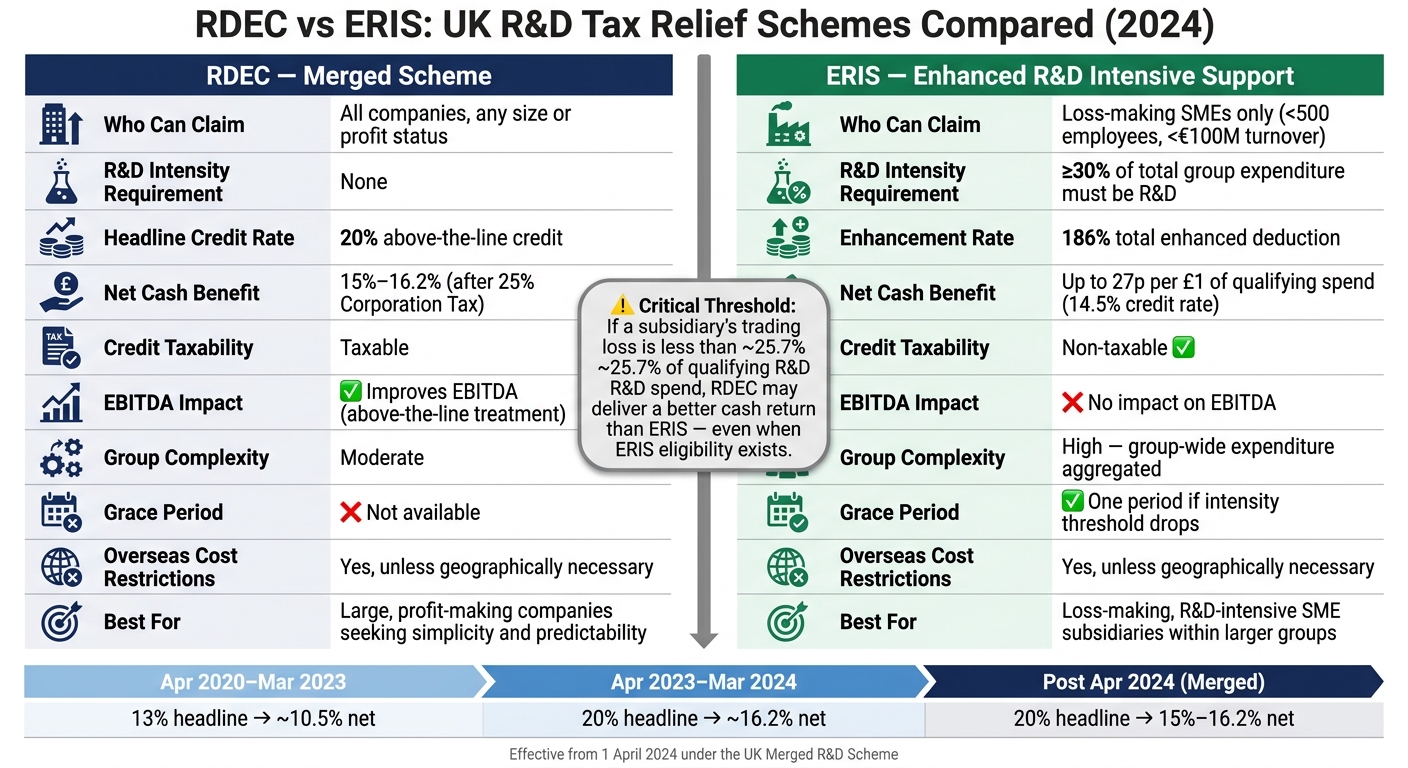
RDEC vs ERIS: UK R&D Tax Relief Schemes Compared (2024)
1. RDEC (R&D Expenditure Credit)
Eligibility and Scope
RDEC is the primary R&D relief available to large companies. These are defined as businesses with 500 or more employees and either an annual turnover exceeding £100 million or gross assets over £86 million. From 1 April 2024, updated R&D rules will apply under a merged scheme. Under this new framework, the entity taking on the financial risk will claim for contracted-out R&D. Additionally, grants or subsidies will no longer reduce the relief available. These changes are expected to bring considerable financial advantages.
Financial Benefits
The RDEC rate stands at 20% of eligible R&D costs. For companies paying the 25% Corporation Tax rate, this results in a net benefit of 15%. Companies with a blended or lower effective tax rate could see a slightly higher benefit of up to 16.2%. Qualifying costs cover a range of expenses, including:
- Staffing costs (salaries, employer National Insurance, and pension contributions)
- Software and cloud computing
- Consumables
- Externally provided workers (EPWs)
- Subcontracted R&D
However, relief for EPW and subcontractor costs is now limited to activities conducted within the UK.
Tax Treatment
RDEC is treated as an above-the-line credit, appearing as pre-tax income rather than just a tax reduction. This accounting treatment boosts reported profits, which can improve financial metrics like EBITDA and operating profit. The credit itself is taxable, which explains why the net benefit is lower than the headline rate. For loss-making companies, the merged scheme applies a notional tax rate of 19% (the small profits rate) to the credit instead of the 25% main rate. This structure adds to RDEC's appeal for larger corporate groups.
Impact on Large Groups
In a corporate group, the RDEC credit offers flexibility. It can be used to offset the Corporation Tax liability of the claimant company or even other group companies. Additionally, it can be applied to other tax liabilities, such as VAT. This adaptability helps optimise tax liabilities across the group.
| Period | Headline Rate | Net Benefit (Approx.) |
|---|---|---|
| 1 April 2020 – 31 March 2023 | 13% | 10.5% |
| 1 April 2023 – 31 March 2024 | 20% | 16.2% |
| Post‐1 April 2024 (Merged Scheme) | 20% | 15%–16.2% |
Groups with SME subsidiaries should also explore whether those entities might qualify for ERIS, which is covered in the next section.
sbb-itb-8ea0335
2. ERIS (Enhanced R&D Intensive Support)
Eligibility and Scope
ERIS is designed specifically for qualifying SME subsidiaries within larger groups, unlike RDEC, which is available directly to large companies. This scheme is exclusively for SMEs with fewer than 500 employees and either a turnover of less than €100 million or a balance sheet total under €86 million. Importantly, even if part of a larger group, SME subsidiaries can qualify independently if they meet the criteria.
However, there’s a crucial limitation: ERIS is only available to SMEs that are loss-making before the additional deduction is applied and whose qualifying R&D expenditure represents at least 30% of their total expenditure. This threshold was reduced from 40% to 30% for accounting periods starting on or after 1 April 2024, broadening access to more R&D-focused businesses. In contrast, RDEC has no such intensity requirement, which makes ERIS more restrictive in this regard.
Another key detail is how eligibility is assessed. HMRC requires that the R&D and total expenditure of the entire group are aggregated. This means a subsidiary’s eligibility depends not just on its own figures but also on the spending patterns of the wider group.
Financial Benefits
For those that qualify, ERIS offers a considerable advantage over RDEC. It provides an additional 86% deduction on qualifying R&D costs, resulting in a total enhanced deduction of 186%. Loss-making companies can surrender these enhanced losses at a rate of 14.5%, translating to as much as 27p for every £1 spent on qualifying R&D. However, if a subsidiary’s trading loss is less than roughly 25.7% of its qualifying R&D expenditure, RDEC could yield better returns.
"ERIS is worth up to 27 pence for every pound of qualifying expenditure identified, compared to 16 pence for loss-making businesses under the merged scheme." - Tom Jones, Director and SME Business Lead, ForrestBrown
Tax Treatment
ERIS differs significantly from RDEC in its tax treatment. While RDEC provides a taxable credit, the ERIS payable credit is non-taxable, meaning the 14.5% credit is received in full. The surrenderable loss is calculated as the lower of the enhanced R&D expenditure (186% of costs) or the total trading loss after the additional deduction.
There’s also a year-of-grace provision for subsidiaries. If a company meets the 30% intensity threshold in one accounting period but falls below it in the next, it remains eligible for ERIS for that following period. This offers some stability for businesses with fluctuating R&D spending cycles, a feature not available under RDEC.
Impact on Large Groups
For large groups, careful planning is essential to navigate the differences between ERIS and RDEC. The connected companies rule requires that R&D and total expenditure across the entire group be aggregated. Even if a subsidiary invests heavily in R&D, its eligibility could be compromised if the wider group’s non-R&D spending reduces the overall ratio.
| Feature | ERIS | Merged RDEC |
|---|---|---|
| Eligible companies | Loss-making SMEs only | All companies, any size |
| Intensity threshold | 30% of total expenditure | None |
| Enhancement rate | 186% deduction | N/A (credit-based) |
| Credit rate | 14.5% on surrenderable losses | 20% above-the-line |
| Net cash benefit | Up to 27% | 15%–16.2% |
| Credit taxability | Non-taxable | Taxable |
To maximise relief, groups must ensure that contracts and project documentation clearly identify which entity "intended or contemplated" the R&D. This determines which entity is entitled to claim, especially when work is contracted within the group. Specialist advisers, such as Zest R&D Tax Advisors, can assist in structuring claims and mapping relationships accurately to optimise the available benefits. Following a comprehensive R&D tax claim checklist can further ensure all compliance steps are met.
Pros and Cons
Deciding between RDEC and ERIS requires careful consideration of your company's specific circumstances. Factors such as company size, profitability, and group-wide R&D expenditure play a key role in determining which scheme is the better fit.
This comparison reflects insights from case studies that explore how large companies can optimise their R&D strategies.
| RDEC (Merged Scheme) | ERIS | |
|---|---|---|
| Who can claim | All companies, regardless of profit status | Loss-making SMEs only |
| R&D intensity requirement | None | At least 30% of total expenditure |
| Net cash benefit | 15%–16.2% depending on tax rate | Up to 27p per £1 of qualifying spend |
| Impact on EBITDA | Credit appears above the line | Does not impact EBITDA |
| Support for R&D spend | Qualifies for relief | Qualifies for relief |
| Group structure complexity | Moderate – standard contracted R&D rules apply | High – group-wide expenditure aggregated for intensity test |
| Overseas cost restrictions | Applies unless deemed geographically necessary | Applies unless deemed geographically necessary |
| Grace period provision | Not available | Available for one period if the intensity threshold drops |
These distinctions highlight the strategic decisions businesses must navigate when selecting an R&D tax relief scheme.
One of RDEC’s standout features is its simplicity and wide applicability. It doesn’t impose an intensity threshold or require companies to be loss-making. Additionally, the above-the-line credit enhances financial metrics, which can be attractive to investors and lenders. For larger, profit-making companies, RDEC provides a steady and predictable return.
On the other hand, ERIS offers a more generous benefit - up to 27p per £1 of qualifying spend - but comes with stricter conditions. The 30% intensity threshold, applied across the entire group, can disqualify subsidiaries if the wider group’s non-R&D spending dilutes the percentage. Moreover, ERIS is limited to loss-making SMEs, excluding profitable subsidiaries, even if they are heavily involved in R&D.
"The new RDEC will be available to all companies undertaking qualifying R&D activities, whereas the ERIS will only be available to loss-making R&D intensive SME companies." - Albert Goodman
For large groups, ERIS isn’t always the optimal choice, even for subsidiaries that meet the criteria. If a subsidiary’s losses are relatively small compared to its qualifying R&D spend, RDEC might deliver a better cash benefit. To make the best decision, careful financial modelling is crucial. Specialist advisers, such as Zest R&D Tax Advisors, can provide valuable guidance to help groups determine the most advantageous route.
Conclusion
For most large companies, RDEC stands out as the preferred option. It applies regardless of whether the company is profitable and has no R&D intensity threshold, typically resulting in a net benefit of 15% to 16.2% after tax. This approach also enhances key financial metrics.
On the other hand, ERIS is tailored for loss-making, R&D-intensive SMEs that meet an intensity threshold of 30% of total expenditure. However, even if a subsidiary qualifies, RDEC often provides a better cash benefit when trading losses are less than approximately 25.7% of qualifying R&D expenditure.
This comparison highlights the distinct strengths and constraints of both schemes. The bottom line? Simply qualifying for ERIS doesn’t mean it’s the best option. Companies should carefully model both scenarios before making a claim.
As Christopher Toms, Compliance Director at RandDTax, puts it:
"The merged regime has thus introduced a new and critical optimisation question: where ERIS eligibility exists, is the trading loss sufficient to justify ERIS?"
Navigating these complexities – from calculating group-wide intensity to addressing restrictions on overseas expenditure and contracted-out R&D – requires expert guidance. Zest R&D Tax Advisors specialises in helping large companies and groups analyse the numbers, structure claims effectively, and ensure compliance with HMRC rules under the merged scheme. In the end, detailed modelling is crucial to selecting the scheme that best fits a company’s specific R&D profile.
FAQs
How do I know if our group should claim RDEC or can use ERIS?
The RDEC scheme is the standard option for most UK companies, including large businesses and SMEs that don’t meet the criteria for other reliefs. However, to claim ERIS instead, your company must meet the following conditions:
- It must qualify as an SME.
- It should be loss-making before applying the additional R&D deduction.
- At least 30% of the total expenditure must be qualifying R&D costs.
If your company doesn’t meet these requirements, the RDEC scheme will apply.
What counts as “total expenditure” for the 30% ERIS intensity test?
When it comes to the 30% intensity test under the Enhanced R&D Intensive Support (ERIS) scheme, the term total expenditure takes on a specific meaning. It refers to the company’s total relevant costs for the accounting period. Importantly, this calculation must include all costs from connected companies worldwide.
Navigating these requirements can be complex, but Zest R&D Tax Advisors are here to help. They specialise in calculating these costs accurately and ensuring your business remains compliant with the latest R&D Tax Relief regulations.
How should we model RDEC vs ERIS for a loss-making subsidiary?
To evaluate whether RDEC or ERIS is better for a loss-making subsidiary, you first need to ensure the company qualifies for ERIS. The criteria are straightforward: the business must be an SME, actively trading, operating at a loss before applying the additional deduction, and allocating at least 30% of its total expenditure to qualifying R&D activities.
Once eligibility is confirmed, assess both schemes. While ERIS offers an 86% additional deduction, RDEC provides a 20% expenditure credit. Carefully model the financial outcomes of each option to determine which delivers the greater benefit for the subsidiary. ERIS may not always be the optimal choice, so a thorough comparison is essential.
Related Blog Posts
Other news stories

R&D Tax Credit Statistics 2026: Why SME Claims Are Falling (And What It Means for You)
HMRC’s R&D tax credit statistics 2026 show SME claims down 19% even as total relief rises — what’s behind the fall and what it means for your claim.

How Does the Patent Box Work? A Complete Guide for UK SMEs
How does the Patent Box work? A plain-English guide to the 10% Corporation Tax rate on patent profits — eligibility, the development condition, the R&D nexus, how to elect, and a worked example.

Autumn Budget 2026 and R&D Tax Relief: What to Watch on 28 October
The Chancellor will deliver the Autumn Budget 2026 on Wednesday 28 October. For any UK company running an R&D tax relief claim — or planning its first — it is worth knowing what is genuinely on the table before the red box opens, and what is simply noise. The short version: after three years of near-constant reform, the R&D regime is finally settling. Most of what matters for your next claim is already law. But a Budget always carries the risk of a technical tweak, and there are a few signals worth tracking. Where the R&D rules stand going into the Budget The big structural change is done. The merged RDEC scheme is now the default for accounting periods beginning on or after 1 April 2024, replacing the old separate SME and RDEC regimes. It gives a taxable expenditure credit of 20% of qualifying R&D costs — worth roughly 15% net once Corporation Tax at 25% is applied. Loss-making, R&D-intensive SMEs are the exception. If your qualifying R&D is at least 30% of total expenditure, you may instead claim under Enhanced R&D Intensive Support (ERIS), which offers a more generous deduction and a payable credit for surrenderable losses. None of […]
