
HMRC R&D Claim Processing Times 2026

HMRC's R&D tax credit processing times in 2026 are highly variable, ranging from weeks to over a year, depending on the claim type and complexity. Here's what you need to know:
- Standard claims (e.g., profit-making SMEs): Typically processed in 4–6 weeks.
- Merged Scheme claims: Resolved within 8–12 weeks.
- Loss-making SMEs using ERIS: Expect 8–14 weeks.
- Compliance-checked claims: Can take 6–18 months or longer.
Key factors affecting timelines include claim complexity, submission quality, and compliance checks. HMRC aims to process 85% of claims within 40 working days, but flagged claims face delays. Accurate documentation and early submissions can help avoid setbacks. For complex cases, seeking expert advice is highly recommended.
Read on for detailed insights into HMRC's processes, timelines, and tips for efficient R&D tax claim submissions.
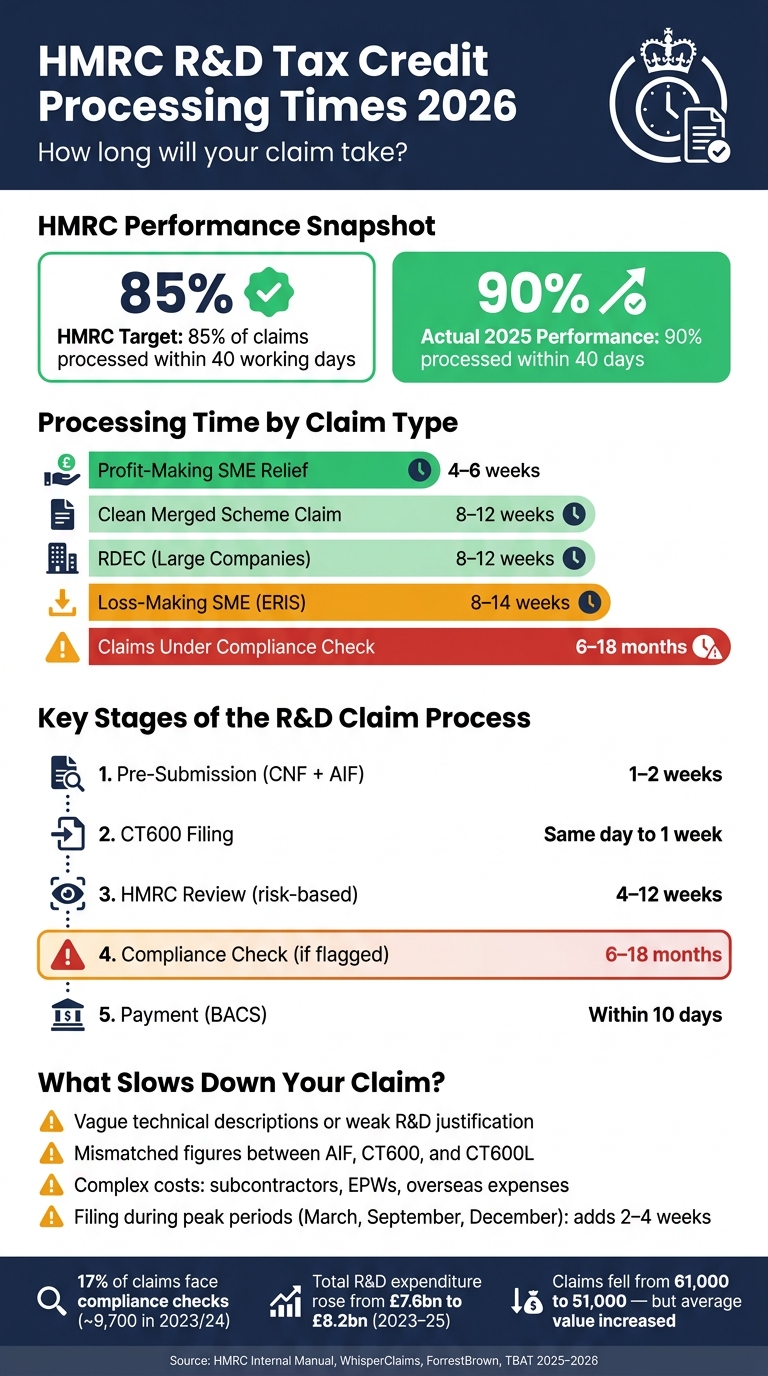
HMRC R&D Claim Processing Times 2026: All Claim Types Compared
HMRC's 2026 Processing Targets and Current Performance
HMRC's Official Processing Targets
HMRC has set a goal to process 85% of R&D tax credit claims within 40 days. This means that within that timeframe, they aim to either pay the credit, request additional details, or reject the claim. For claims flagged as high-risk, the timeline adjusts slightly - HMRC intends to initiate a formal compliance enquiry within 60 days of receiving the claim.
"Our aim is to pay 85% of payable tax credits within 40 days or contact you regarding the claim within 40 days." - HMRC Internal Manual
In 2026, compliance enquiries transitioned from the ISBC (Individuals and Small Business Compliance) teams to WMBC (Wealthy and Mid-Sized Business Compliance) teams, which now include named caseworkers. Ian Davie, Senior Consultant at TBAT, expressed optimism about this change:
"The move away from C&P and utilising ISBC... is a good move. WMBC has built a more solid reputation for handling claims, and this can only be an improvement."
Let’s now examine how these targets compare with recent performance data.
2026 Data on Actual Processing Times
These official targets serve as a benchmark, but how does HMRC's actual performance measure up?
In practice, HMRC has exceeded its goals. During 2023–24, Exchequer Secretary James Murray reported that 92% of claims were processed within 40 days, and in 2025, this figure stood at 90% - still comfortably above the 85% target.
"HMRC aims to process 85% of claims within 40 days, and hit 90% of this last year." - Jen Badger, WhisperClaims
However, these overall figures reveal only part of the picture. The total number of R&D claims dropped from 61,000 in 2023/24 to 51,000 in 2024/25. At the same time, the average value of claims increased, with total R&D expenditure rising from £7.6 billion to £8.2 billion over the same period. This shift indicates that while claims are fewer, they tend to be larger and more complex.
Processing times in 2026 vary significantly depending on the type of claim:
| Claim Type | Typical Processing Window |
|---|---|
| Profit-making SME Relief | 4–6 weeks |
| Clean Merged Scheme Claim | 8–12 weeks |
| Loss-making SME (ERIS) | 8–14 weeks |
| RDEC (Large Companies) | 8–12 weeks |
| Claims under Compliance Check | 6–18 months |
The difference in processing times is striking. A straightforward claim, such as one from a profit-making SME, might be resolved in under six weeks. On the other hand, claims that undergo compliance checks could take over a year to conclude. This disparity highlights how claim complexity and operational changes affect timelines, making it crucial for businesses to ensure their claims are accurate and well-prepared from the outset.
sbb-itb-8ea0335
Factors That Affect HMRC R&D Claim Processing Times
Claim Complexity and Quality
The quality of your submission plays a major role in how quickly HMRC processes your R&D claim. When your documentation clearly outlines the qualifying technical uncertainty, the existing baseline knowledge, and the steps your team took to resolve the challenge, HMRC caseworkers can process the claim more efficiently. On the other hand, vague or generic descriptions, like "improving internal processes" without a clear scientific or technical challenge, are likely to face delays as they may trigger further scrutiny.
Financial accuracy is just as critical. Discrepancies between figures in the Additional Information Form (AIF), CT600, CT600L, and tax computations can lead to manual reviews. This is especially true if costs tied to payroll, pensions, NIC, and the trial balance don't align. Claims involving subcontractors, Externally Provided Workers (EPWs), or overseas expenses add another layer of complexity. HMRC often reviews these claims in depth to assess contract terms and financial risk allocation.
"The single biggest variable [in enquiry length] is not the claim size but the quality of your original documentation." - IP Tax Solutions
These factors explain why some claims face extended timelines during compliance reviews.
Increased Compliance Checks
In the 2023/24 tax year, approximately 17% of R&D claims - around 9,700 out of 61,000 - underwent compliance checks. When a claim enters compliance review, processing times increase significantly. While straightforward claims are typically resolved within 8–12 weeks, those under compliance enquiry can take 6–18 months. Cases involving suspected fraud or particularly complex issues may stretch beyond two years.
HMRC has centralised its compliance activity under the Wealthy, Mid-Sized and Business Compliance (WMBC) teams. These teams use a named caseworker model for handling complex claims. Additionally, HMRC employs AI tools to summarise AIF content and prioritise cases for review. However, HMRC has clarified that "no AI tools are used to make decisions or determine claim validity". Claims flagged as high-risk - such as those with unusual expenditure for their sector, significant year-on-year increases, or weak technical justifications - are now escalated more quickly.
Beyond the quality of individual claims, broader operational factors within HMRC also influence processing times.
Seasonal and Staffing Factors at HMRC
External factors, such as peak filing seasons and staffing changes, also impact how long it takes to process claims. During busy Corporation Tax filing periods, submission volumes increase significantly. Even well-prepared claims may face delays of two to four weeks compared to off-peak periods.
HMRC's staffing adjustments are another factor. To handle the growing complexity of R&D claims under the merged scheme, HMRC is reallocating staff from the Individual & Small Business Compliance (ISBC) teams to the WMBC unit. This shift aims to create a more specialised and accountable workforce. As Jen Badger of WhisperClaims explained: "Enquiry work is being 'refocused' to within the WMBC I&R team and away from the ISBC C&P teams... some of these team members will be redeployed to the WMBC team, so as not to lose the expertise."
While this transition is underway, it's a good idea to monitor your Corporation Tax online account for digital updates, as these may arrive before postal notices.
Planning Your R&D Claim Timeline in 2026
Knowing how long your R&D claim might take is key to managing cash flow and avoiding surprises. The timeline largely depends on the type of claim and how well-prepared your submission is.
Timelines for Standard Claims
For a well-prepared claim under the Merged Scheme, the process typically spans 8 to 12 weeks from submission to payment. However, profit-making SMEs often see faster results, with claims resolved in 4 to 6 weeks, provided their documentation is thorough. On the other hand, loss-making SMEs using the Enhanced R&D Intensive Support (ERIS) route usually face slightly longer waits - around 8 to 14 weeks - as additional verification steps are needed for cash repayments. Once HMRC processes a claim, payments generally arrive within 10 days, though larger sums may undergo extra security checks.
"For most companies, this means you should expect it to take around 50 days in total from the submission of your claim to receiving your R&D tax credit." - Adam Palmer, Senior Tax Manager, ForrestBrown
To avoid delays, steer clear of filing during peak periods like March, September, or December. These months often see a surge in submissions, which can add two to four weeks to the process, even for well-prepared claims. As always, knowing how to submit R&D claims correctly is your best defence against extended timelines.
Timelines for Complex or Queried Claims
If your claim is flagged for a compliance check, the process can take a lot longer. Most enquiries range from 6 to 18 months from the initial notice to resolution. For particularly complex or high-risk cases, the timeline can stretch beyond two years, and appeals to the First Tier Tribunal may add an extra 24 months or more.
Simple administrative errors, like mismatched figures between the AIF and CT600, can also cause delays, pushing your claim into manual review. Worse still, failing to submit the AIF before the CT600 can lead to an automatic rejection of your claim.
Key Stages of the Claim Process
Here’s a breakdown of the main stages and how long each typically takes:
| Stage | What Happens | Typical Duration |
|---|---|---|
| Pre-submission | Submit CNF (if required) and AIF via HMRC's portal | Allow 1–2 weeks |
| CT600 filing | File Company Tax Return with CT600L supplementary pages | Same day to 1 week |
| HMRC review | Risk-based assessment; most clean claims processed automatically | 4–12 weeks |
| Compliance check | Formal enquiry opened; evidence requested in stages | 6–18 months |
| Payment | BACS repayment issued after processing is complete | Within 10 days |
It’s important to note that receiving payment doesn’t mean your claim is fully approved. HMRC can still open a compliance check within 12 months of your filing date, even after issuing a repayment. Keeping detailed records - like project logs, timesheets, and internal communications - can help you respond quickly if this happens.
These timelines highlight how crucial it is to prepare your claim carefully. In the next section, we’ll dive into strategies to help you streamline your R&D submissions.
How UK Businesses Can Improve Their R&D Claims in 2026
Submitting Accurate and Complete Claims
The quality of your R&D tax relief submission can directly impact how quickly HMRC processes it. With HMRC now reviewing 20% of all claims and compliance enquiries happening at roughly 40 times the levels seen before COVID, businesses must meet stricter standards to avoid delays.
A strong claim needs to clearly outline the scientific baseline, the specific advance being pursued, and the uncertainties faced. It should also include reconciled financial data, such as payroll and ledger figures, to ensure everything aligns. Any discrepancies could lead to a manual review. To strengthen your claim further, name the lead engineers or scientists involved, and include their qualifications, as HMRC requires a "competent professional" to be clearly identifiable.
Submitting your claim well before the deadline is another essential step. Rushed claims, especially those prepared close to corporation tax deadlines, are more likely to have inconsistencies between the technical and financial sections. If you're claiming for the first time or haven't submitted a claim in the past three years, remember that your Claim Notification Form must be lodged within six months of the end of your accounting period. Missing this deadline means your claim won’t proceed.
Following an [R&D tax claim checklist] (https://www.zest.tax/blog/rd-tax-claim-checklist-essential-steps) to ensure your submission is thorough and accurate is just one part of the process. Expert guidance can make a significant difference in navigating the complexities of R&D claims.
Getting Expert Help with Claims
With HMRC placing greater emphasis on documentation quality, working with specialist advisers can significantly improve your chances of a smooth and successful claim. Specialists can save your team time and reduce delays by handling the more complex aspects of the process. For example, expert-prepared SME claims typically require minimal input from your team. Advisers can take care of everything - from drafting the technical narrative and reconciling financial data to submitting the necessary forms.
Firms like Zest R&D Tax Advisors provide comprehensive support, including preparing and submitting claims and defending against compliance checks if HMRC opens an enquiry. As the gap between well-prepared and poorly structured claims widens, having a specialist can mean the difference between fast processing and a prolonged enquiry.
Beyond expert assistance, staying informed about HMRC updates is equally vital for avoiding unnecessary delays.
Keeping Up with HMRC Processing Trends
In addition to submitting a thorough claim, keeping track of HMRC’s evolving practices is key. One notable development is the Targeted Advance Assurance pilot, launched in May 2026. This initiative allows SMEs to seek early clarity from HMRC on up to two complex areas - such as overseas expenditure or contracted-out R&D rules - before filing their return. HMRC aims to respond to these applications within 40 calendar days. For businesses with particularly complex claims, this pilot could be a valuable option.
Staying informed about changes like the mandatory adviser registration introduced on 18 May 2026 and software updates for the merged scheme is crucial. These updates help ensure your claim avoids the slower manual review process, keeping things on track.
Conclusion and Key Takeaways
The timeline for HMRC's processing of R&D tax relief claims continues to evolve, with key points that businesses need to keep in mind.
HMRC aims to process 85% of R&D tax relief claims within 40 days. In 2025, they surpassed this goal, processing 90% of claims within the target timeframe. However, by 2026, processing times have become more variable. For clean merged scheme claims, the processing time is typically 8–12 weeks. Loss-making SMEs using the ERIS route may face waits of 8–14 weeks, while compliance-checked claims can take anywhere from 6 to 18 months to be resolved.
A critical insight for 2026 is that the quality of your claim significantly affects how quickly it is processed. Discrepancies between the Advance Information Form (AIF), CT600, and the technical narrative can trigger manual reviews, leading to delays. For instance, failing to update software to reflect the new CT600L boxes (L71–L73A), which came into effect on 6 April 2026, is an avoidable mistake that can slow things down.
It’s also important to note that receiving payment does not equate to final approval. Adam Palmer, Senior Tax Manager at ForrestBrown, explains:
"HMRC processing and payment of R&D claims is separate to its compliance process. Just because your claim has been processed and you've received your money does not mean your claim has been checked or 'approved'."
HMRC retains the right to open a standard enquiry within 12 months of the filing date, underscoring the importance of maintaining thorough documentation and ensuring claim accuracy even after submission.
Working with a specialist, such as Zest R&D Tax Advisors, can make a significant difference. They can assist in preparing precise documentation and addressing HMRC queries efficiently. By 2026, the difference between a well-prepared claim and a poorly constructed one can directly influence how quickly your claim is resolved.
FAQs
Why might my R&D claim take much longer than 40 working days?
HMRC typically aims to process most R&D claims within 40 working days, but delays do happen. These can arise for several reasons, such as compliance checks, which may stretch from 6 to 12 months or even longer, or submissions that lack quality - think weak technical details or missing documents. Claims that are particularly intricate might also need manual review, slowing things down further.
Other factors like peak filing periods or delayed responses to HMRC's questions can add to the wait. Seeking expert advice can streamline the process, ensuring your claim aligns with HMRC's expectations and avoids unnecessary hold-ups.
How can I reduce the risk of an HMRC compliance check on my claim?
To reduce the chances of triggering an HMRC compliance check, it’s crucial to submit a claim that’s thorough, detailed, and backed by solid evidence. Keep well-organised records, including financial accounts, project documentation, and timesheets that clearly connect expenses to the qualifying activities. Make sure your technical narrative is specific, outlining the uncertainty tackled, the progress aimed for, and how the work goes beyond standard knowledge in the field. Our guide to the R&D compliance records to keep sets out exactly what to retain. For SMEs, applying for Advance Assurance can provide extra clarity and peace of mind, particularly for projects that might be seen as higher risk.
If HMRC pays my R&D credit, can they still open an enquiry later?
If you've received payment for your R&D tax credit claim, it's important to know that HMRC can still investigate your claim. Payment doesn't stop them from conducting a compliance check, provided it's within the statutory time limits for Corporation Tax returns.
Should HMRC determine that your claim lacks sufficient support, they have the authority to adjust your tax return and demand repayment of the credit. To minimise such risks, Zest R&D Tax Advisors can assist in ensuring your claims and documentation are solid and well-prepared.
What is the time limit for claiming R&D tax credits?
You generally have two years from the end of the accounting period in which the R&D costs were incurred to submit your claim. For an accounting period ending 31 December 2024, for example, the deadline to claim is 31 December 2026 — miss it and the relief for that period is normally lost.
There is also an earlier deadline that catches companies out. For accounting periods beginning on or after 1 April 2023, many companies must submit a Claim Notification form within six months of the end of the period of account — well before the two-year window closes — or they lose the right to claim at all. If you are claiming for the first time, or have not claimed in the last three years, check this requirement before anything else.
Related Blog Posts
Other news stories

R&D Tax Credit Statistics 2026: Why SME Claims Are Falling (And What It Means for You)
HMRC’s R&D tax credit statistics 2026 show SME claims down 19% even as total relief rises — what’s behind the fall and what it means for your claim.

How Does the Patent Box Work? A Complete Guide for UK SMEs
How does the Patent Box work? A plain-English guide to the 10% Corporation Tax rate on patent profits — eligibility, the development condition, the R&D nexus, how to elect, and a worked example.

Autumn Budget 2026 and R&D Tax Relief: What to Watch on 28 October
The Chancellor will deliver the Autumn Budget 2026 on Wednesday 28 October. For any UK company running an R&D tax relief claim — or planning its first — it is worth knowing what is genuinely on the table before the red box opens, and what is simply noise. The short version: after three years of near-constant reform, the R&D regime is finally settling. Most of what matters for your next claim is already law. But a Budget always carries the risk of a technical tweak, and there are a few signals worth tracking. Where the R&D rules stand going into the Budget The big structural change is done. The merged RDEC scheme is now the default for accounting periods beginning on or after 1 April 2024, replacing the old separate SME and RDEC regimes. It gives a taxable expenditure credit of 20% of qualifying R&D costs — worth roughly 15% net once Corporation Tax at 25% is applied. Loss-making, R&D-intensive SMEs are the exception. If your qualifying R&D is at least 30% of total expenditure, you may instead claim under Enhanced R&D Intensive Support (ERIS), which offers a more generous deduction and a payable credit for surrenderable losses. None of […]
